
Solar panel nerds like me could earn at least £700 a year’
Tony Hazell reveals how, after recouping the cost of his equipment, he now makes it to bedtime every night without paying a penny for his energy
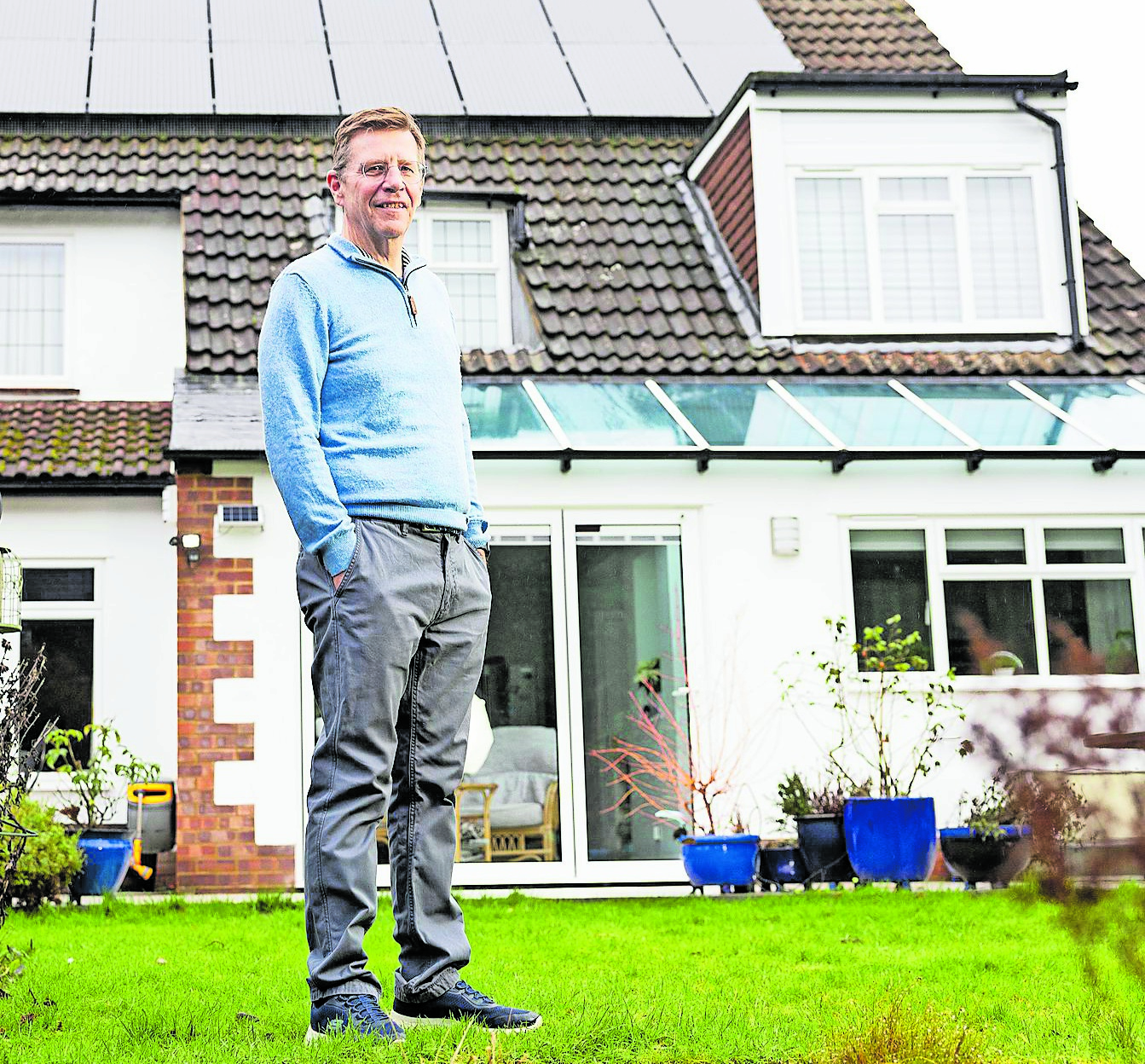
Tony Hazell now has a battery to store energy from his solar panels
It’s a bright sunny day at the beginning of March and I’m hoping the grimmest and dullest of winters is finally behind us.
I’m a solar panel nerd… and mine are providing about 3.5 kilowatts of energy at present. This is enough to power our home and top up a battery, which in turn should be enough energy until bedtime and beyond.
But at one stage in January they were producing 50 watts at midday, which was barely enough to power my computer.
We had panels installed in November 2014, when 16 of them cost us £5,500.
Immediately I became obsessed with sunshine and light levels. I have a spreadsheet showing how much energy they’ve produced every month for 136 months. I can bring any conversation to an abrupt halt with facts about the sunniest summers and the dullest winters. Both 2025, since you ask, although spring 2020 was a humdinger.
On a sunny day will I will be sprinting round the house to fill the washing machine, run the dishwasher, vacuum the floor and tackle the ironing.
The financial facts behind solar panels are compelling. Early adopters like me were paid for generating electricity and for exporting it to the grid. The tax-free tariffs were guaranteed for 20 years and increase every year in line with the retail prices index measure of inflation.
We are paid about 26p for every kilowatt hour (kWh) of electricity generated, and have pocketed £8,694 in total, leaving me well in profit. We’ve also saved untold thousands in electricity and gas we haven’t had to buy because we have cooked, cleaned and heated our water using the power of the sun.
Now the government wants to inspire a rooftop revolution with the aim of tripling the 1.6 million homes that have solar panels by 2030. The carrot will be £15 billion in grants and interest-free or low-interest loans focusing on heat pumps, solar panels and batteries.
In 2024 solar accounted for about 5 per cent of the UK’s electricity generation — but that includes solar farms. This isn’t without controversy because 68 per cent of solar panels imported by the UK in 2024 came from China, but that’s a row for politicians. We homeowners should be more interested in keeping down our energy bills.
So what’s in it for you? You would do better to ask Matthew Parris about heat pumps. All I know is that it appears you have to leave them turned on all the time.
For someone who believes in turning off radiators in empty rooms and teaches the grandchildren the value of woolly jumpers, this feels wasteful and potentially very expensive. But solar panels, especially combined with a battery, can take you off the grid for a decent part of the day, saving hundreds of pounds a year.
I bought a battery last summer (after the government finally stopped charging VAT on retrofitted ones). The result was that in July we bought 17 kWh of electricity, costing less than £4. Our gas cost £1.21 before the standing charge because most of our water was heated by an immersion heater using solar power. Our cooking is all electric.
Unfortunately, homeowners are no longer paid merely for generating electricity (that privilege goes to multinationals that run wind farms, gas and nuclear plants). But you can sell spare electricity to a power firm, although finding the best deal can be complicated and rates can depend on where you live. The best rates tend to be paid by the energy firm that fits your panels. For example, Good Energy pays up to 25p a kWh for the first year, falling to 15p. EDF pays 24p for the first year.
The top rates are paid to those who have batteries and smart meters and take their power from the same firm. Step forward Octopus, which will pay up to 32p per kWh at peak times if you let it take complete control. Other firms pay up to 15p or 16p if you buy your power from them, while standalone export tariffs can be as low as 1p to 6p.
The barrier to solar is the upfront cost. Our 4kW of panels cost about £5,500 and paid for themselves several years ago.
In July we only had to buy £4 of electricity — 17kWh
The battery, which will store 5 kWh, cost about £2,500 last year. An online calculator at the Energy Saving Trust, which promotes energy efficiency, tells me a 5.5kW system without a battery would cost about £8,400 today.
Savings and export payments should come to about £735 a year, meaning an 11-year payback if I bought now. But it all depends on tariffs, where you live and the weather. It’s a big commitment, although an interest-free loan makes the prospect rosier than finding the cash upfront.
The right sort of home helps. A large roof facing roughly between southeast and southwest is best. You need a decent pitch on it rather than a flat roof to catch the best angle on the sun (unless you’re reading this somewhere around the equator). The further south you live the better.
And watch out for scams. Panels should come with long guarantees so you don’t need insurance, expensive cleaning or maintenance. Our window cleaner cleans ours for £20 every spring.
I have never regretted investing in solar, although my wife may have a different view.
Since buying the battery my daily aim is to make it to bedtime using purely the electricity stored in the battery, which can mean rushing around the house turning off appliances and suggesting Mrs H washes her hands with cold water rather than using the Quooker hot tap.
My latest ruse is to move our main meal to the middle of the day, blaming the grandchildren. “It’s much simpler if we just give them a light meal before they go home.”
We bought an electric car in the autumn which has increased my solar nerdiness to new levels. We switched to an energy tariff called Intelligent Octopus Go, which means more expensive electricity in the day but 7p per kWh overnight and whenever Octopus charges the car.
The charger was fitted by a superb electrician who created a spaghetti of cables to ensure that any electricity we generate first powers the house, then fills the battery, then heats the water and finally charges the car. Admittedly it’s never going to fill the car battery on its own, but every kilowatt hour is 3.5 miles.
Best of all are the phone apps. My greatest joy comes if at bedtime there is still power in the battery. I then turn it off using the app, while Mrs H rolls her eyes, and we use 7p overnight power. In the morning when we are back on normal rates I turn the battery back on and make our morning tea using the previous day’s free sunlight.
SUNDAY TIMES 8/03/2026
 RIBA Chartered Architects & Planning Consultants